
Updated November 2026 · Southern New Hampshire
Dental office shredding in NH: charts, x-rays and the 7-year rule
Dental office shredding for New Hampshire practices starts with one statute: keep paper, electronic and radiographic records for at least 7 years after the last treatment, longer for minors. This guide covers what to shred, what to bag separately, what it costs, and how to clear the files when you close or sell a practice.
99¢ per pound at our Tewksbury drop-off. Certificate of Destruction on every job.
- 99¢ per pound
- Since 2007
- BBB A+ rated
- HIPAA BAA on request
Quick answer
New Hampshire dentists must keep paper, electronic and radiographic records for at least 7 years from the last treatment, and for minors at least 7 years past the age of majority (RSA 317-A:27-a). Once that clock runs out, New Hampshire Document Shredding destroys the paper at 99 cents per pound at its Tewksbury office, or $20 per banker’s box at 10 or more boxes, plus $34.90 per job, with x-ray film and devices bagged apart and quoted per item. It is the same medical shredding service NH physician practices use, with a Business Associate Agreement on request and a certificate for your HIPAA file.
What dental office shredding actually covers
A dental practice makes paper at every chair and every desk. The chart is only part of it. Health history forms, consent forms, insurance claims, lab slips and the day sheet all carry a patient name next to something private, and every one of them counts as protected health information under HIPAA.
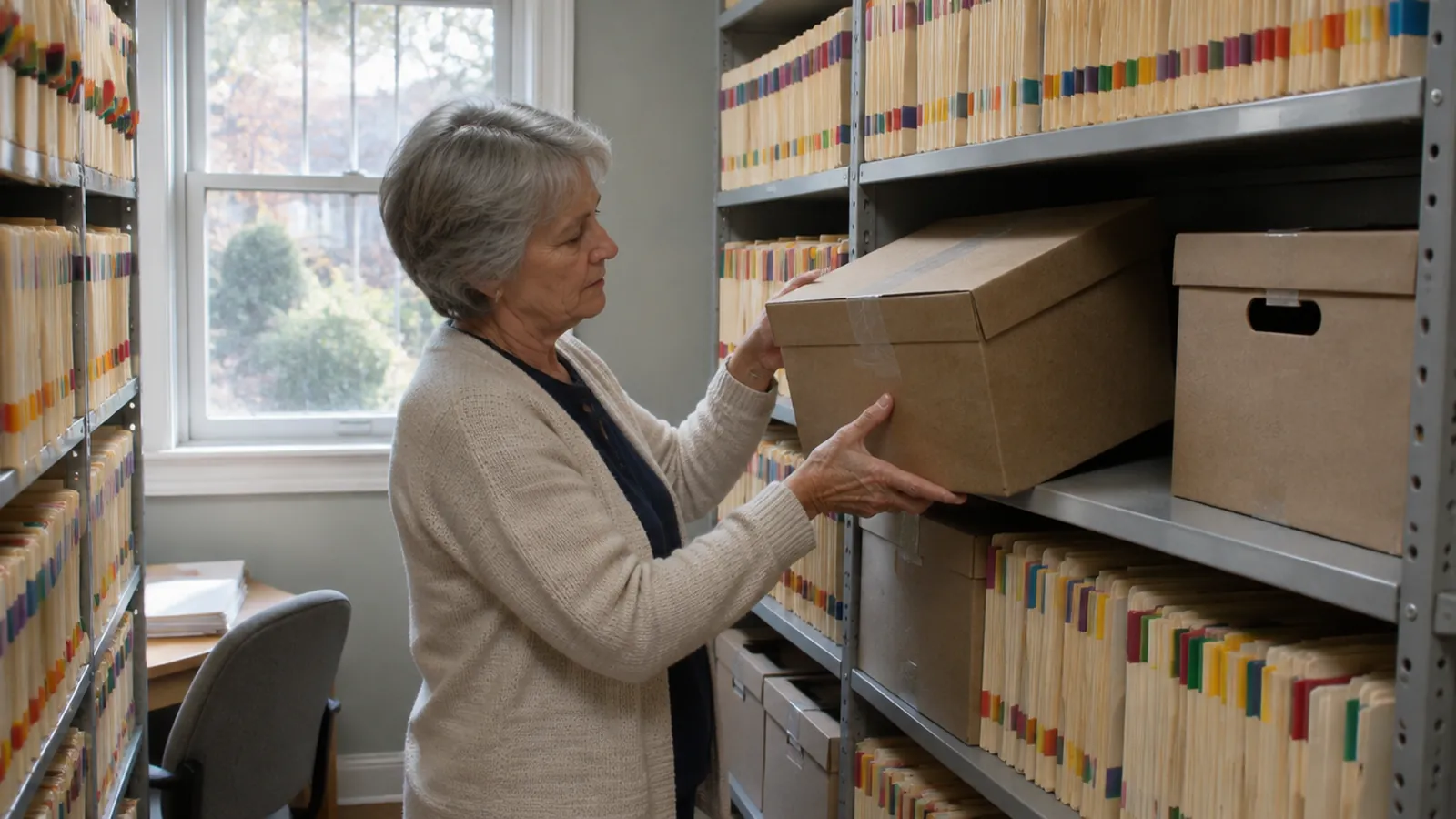
Most offices we see from Salem, Nashua and Manchester went digital years ago and still have a back room full of paper. Old charts sit in color-coded folders on open shelves. Insurance paperwork from the years before electronic claims fills banker’s boxes in the basement. That paper is the real job.
The useful habit is simple. Anything with a patient name, date of birth, insurance ID or treatment detail goes in a locked bin, never the recycling tote. Staff should not have to decide page by page. If it came from a patient file, it gets shredded.

Clinical charts
Paper charts, perio charting, treatment plans, progress notes, referral letters, specialist reports, and printed copies of records sent to another dentist.
Insurance and billing
Claim forms, predeterminations, explanations of benefits, remittance printouts, copies of insurance cards and photo IDs, ledgers, payment plans and collection letters.
Front desk paper
Medical history updates, consent forms, sign-in sheets, the day sheet, recall postcards that came back, phone messages and HIPAA acknowledgment forms past their keep date.
Lab and prescriptions
Lab prescriptions for crowns and appliances, returned lab slips, prescription copies and pharmacy callback notes. Each one names a patient next to a procedure.
The 7-year rule for NH dental records
Retention comes before any shredding decision. In New Hampshire, the rule for dentists is written into statute, not just board guidance. RSA 317-A:27-a says a dentist “shall maintain patients’ paper or electronic, and radiographic records, for at least 7 years from the time the dentist or dental hygienist last treated the patient.”
Minors get a longer clock. The same section says that for a minor patient, a dentist shall keep the “paper or electronic, and radiographic dental records for at least 7 years past the age of majority.” A chart for a child seen at age 8 can outlive several staff turnovers, so flag pediatric charts on the folder itself.
| Record | Minimum before shredding | Where the rule lives |
|---|---|---|
| Adult patient chart, paper or electronic | 7 years from the last treatment | RSA 317-A:27-a |
| Radiographs of an adult patient | 7 years from the last treatment | RSA 317-A:27-a names radiographic records |
| Any record of a minor patient | 7 years past the age of majority | RSA 317-A:27-a |
| Prior patients’ access to records | An ongoing duty for at least 7 years | Den 501.01(h), NH Board of Dental Examiners |
| HIPAA policies, BAAs and disposal logs | 6 years from creation or last effective date | 45 CFR 164.530(j)(2) |
Notice what starts the clock. It is the last treatment, not the first visit and not the date the chart was opened. A patient who came in from 2010 to 2022 and then moved away has a chart that runs to at least 2029.
These are minimums. Your malpractice carrier, a payer contract or an open dispute can require longer. We do not give legal advice, so if a chart has any open question attached, check with your carrier before it goes in a box.
For the wider picture of how long a business keeps payroll, tax and corporate files, see our document retention guide.
X-rays: film, digital images and the drives behind them
Radiographs are the part of dental office shredding that trips people up. The statute treats them exactly like the chart for retention. The disposal method depends entirely on what they are made of.
Film
Older practices still have film in mounts and envelopes, often filed inside the paper chart. Film is not paper. Pull it out, keep it in a separate bag, and list it when you book. It is physically destroyed and quoted per item, not run through the paper shredder with the folders.
Keep the film with its retention date in mind. A film set filed inside a chart is on the same 7-year clock as the chart, so it leaves the office in the same purge, just in a different bag. Our post on whether to shred medical x-rays explains the film question in more detail.
Digital images
Digital radiographs never touch paper, but they still need a disposal plan. HIPAA’s Security Rule at 45 CFR 164.310(d)(2)(i) requires policies “to address the final disposition of electronic protected health information, and/or the hardware or electronic media on which it is stored.”
That means the old imaging computer in the corner, a retired server, backup drives and any USB stick used to send images to a specialist. Those are destroyed and quoted per item. See our page on hard drive destruction for what the process covers.
Printed images are another matter. A panoramic printed on paper for a patient conversation, or a copy sent with a referral letter, is plain paper with PHI on it. It goes in the shred box like any other page.
What the dental board and HIPAA say about destroying records
The NH Board of Dental Examiners has its own disposal line, and it is short. Den 501.01(m) says: “When dental records are being discarded, dentists shall destroy them by some method that maintains confidentiality.” Throwing charts in a dumpster fails that test. So does a recycling bin at the curb.
HIPAA adds the federal layer. The Privacy Rule at 45 CFR 164.530(c) requires “appropriate administrative, technical, and physical safeguards to protect the privacy of protected health information.” HHS breach guidance published in the Federal Register in 2009 says paper and film count as destroyed when they “have been shredded or destroyed such that the PHI cannot be read or otherwise cannot be reconstructed.” The same guidance adds that “Redaction is specifically excluded as a means of data destruction.”
Cross-cut, not strip-cut
A strip-cut office shredder leaves long ribbons that can be lined back up. Cross-cut shredding cuts both ways, which fits the “cannot be reconstructed” language in the federal guidance.
A signed BAA
Any vendor who receives your patient files is a business associate. Under 45 CFR 164.502(e) and 164.504(e), you need written assurances first. We sign a Business Associate Agreement on request.
Proof on file
Every job comes with a Certificate of Destruction. File it with your disposal log and keep both for six years, the HIPAA documentation period in 45 CFR 164.530(j)(2).
Our checklist of HIPAA shredding requirements walks through each rule with the exact text, which helps when you write or update your office policy.
What dental office shredding costs
Pricing is the same for dental, medical and household paper. You pay 99 cents per pound under 10 boxes, and a banker’s box of charts weighs about 30 pounds. At 10 boxes or more, the flat rate is $20 per large box or $15 per small box. Every job adds $34.90: the $14.95 HIPAA filing fee for the certificate paperwork and the $19.95 environmental fee for recycling the shred.
| Banker’s boxes | Drop-off in Tewksbury | Zone 1 pickup | Zone 2 pickup | Zone 3 pickup |
|---|---|---|---|---|
| 1 box (about 30 lb) | $64.60 | $194.55 | $224.55 | $264.55 |
| 5 boxes (about 150 lb) | $183.40 | $313.35 | $343.35 | $383.35 |
| 10 boxes ($20 each) | $234.90 | $364.85 | $394.85 | $434.85 |
| 20 boxes ($20 each) | $434.90 | $564.85 | $594.85 | $634.85 |
Zone 1 covers the border towns such as Salem, Pelham, Windham and Plaistow. Zone 2 covers greater Nashua and Manchester, and Zone 3 covers the Seacoast and points farther north. If your town is not on that list, the zone is confirmed when you book. Pickup prices assume ground-level or elevator access, and a handling fee for stairs is quoted up front.
Our opinion: a dental office near the line with a few boxes should drive them down Route 38 or I-93 on a slow afternoon. A practice clearing a basement of 20 boxes should book the pickup. The math for a full year of practice paper is in our post on what medical shredding costs per month, and the full price list is on our shredding rates page.
Closing or selling a dental practice
A closing is the biggest records job most dentists ever face. The board rule sets the order of events. Den 501.01(g) says a dentist about to close a practice in New Hampshire shall inform patients of record “to allow 3 months, when possible, for patients to obtain copies of their records or have their records sent to another dentist.”
The same paragraph requires written notice to the board of your intent to close, with “the name, address, and telephone number of the licensee to whom the dentist’s patient records will be transferred.” Paragraph (h) then gives prior patients an ongoing right of access for at least 7 years. Charts inside that window go to the receiving dentist. They do not go to us.
- Send the patient noticeGive patients of record the 3-month window where possible, with clear instructions for copies or a transfer to another dentist.
- Name the records custodianTell the board in writing who will hold the charts. In a sale this is usually the buyer. Put it in the purchase agreement so nobody argues later.
- Split the charts by dateSeparate charts still inside the 7-year window, and any minor’s chart, from those whose clock has run out. Only the expired pile is ready for shredding.
- Pull film and devicesBag x-ray film, imaging CDs, old computers and phones apart from the paper so they can be quoted per item.
- Book one job, not fiveOne pickup or one witnessed session keeps the per-job fees to a single $34.90 and gives you one certificate for the whole purge.
- Keep the certificate with the closing fileStore it with the board notice and the custodian’s contact details, so a future records request has a clear answer.
In a sale, the buyer usually wants the active charts and nothing else. The seller is left with expired charts, old ledgers and insurance boxes. That leftover paper is the cleanest shredding job of all, because it is already sorted. A selling dentist who wants to see it done can book witnessed shredding at $1.99 per pound with a $100 minimum, plus $34.90 per job.
A front desk routine for dental office shredding
Most PHI leaks in small offices happen before any vendor is involved. A sign-in sheet left on the counter or a box of claim forms by the back door does more harm than anything that happens at a shredder. A short routine fixes most of it.
- Put a locked bin at the front desk, one in the business office and one near the sterilization area where lab slips pile up.
- Seal full bags or boxes the same day and move them to a locked closet. Never stage them in a hallway.
- Leave the staples, paper clips and file folders in. You do not need to remove them. Do pull three-ring binder hardware and hanging-folder frames.
- Keep film, discs and USB sticks in a separate labeled bag.
- Log each job: the date, number of boxes and the date range of charts.
- Train new hires on the bin on day one. HIPAA’s training standard at 45 CFR 164.530(b) covers every workforce member.
For drop-offs, our Tewksbury office is on Route 38 near the I-495 interchange, about 15 minutes south of the Salem and Pelham line. Staff help you unload, paper is shredded the same business day, and free parking is out front. The drop-off shredding page has the details. If nobody can leave the office, our off-site shredding pickup brings the boxes to us by appointment.
Nashua practices share a lot with dental offices on this front. Our post on medical office shredding in Nashua shows a realistic volume for a Zone 2 office, and our page on the certificate of destruction explains each field on the form you file.
Frequently asked questions
How long does a New Hampshire dentist have to keep patient records?
At least 7 years from the last time the dentist or hygienist treated the patient, under RSA 317-A:27-a. The rule covers paper, electronic and radiographic records. For a minor, the minimum is 7 years past the age of majority. Your malpractice carrier or a payer contract can ask for longer, so check before you shred a chart with any open issue.
Can we shred dental x-ray film with the paper charts?
No. Pull film out of the charts and put it in a separate bag. Film is physically destroyed and quoted per item, apart from the paper shredding. Printed radiograph images on regular paper can go in the shred box with the charts. Tell us about film when you book online or call (978) 636-0301 so we can price it before the job.
What do we do with digital x-rays on an old computer?
HIPAA’s Security Rule at 45 CFR 164.310(d)(2)(i) requires a policy for the final disposition of electronic PHI and the hardware it sits on. When you retire an imaging computer, server or backup drive, have the drive destroyed. We physically destroy drives, phones and USB sticks and quote them per item. The certificate lists what was destroyed.
Does the NH dental board say how records must be destroyed?
Den 501.01(m) says that when dental records are being discarded, dentists shall destroy them by a method that maintains confidentiality. It does not name a machine. HHS breach guidance says paper counts as destroyed when shredded so the PHI cannot be read or reconstructed. Cross-cut shredding at our Tewksbury office meets that description, with a certificate for your file.
We are closing our dental practice. What happens to the charts?
Under Den 501.01(g), give patients of record 3 months, when possible, to get copies or transfer records, and tell the board in writing who will hold the charts. Charts still inside the 7-year window go to that custodian. Only charts whose clock has run out should be shredded. Book one job for the purge so you pay the $34.90 per-job fees once.
How much does it cost to shred 10 boxes of dental charts?
At 10 or more banker’s boxes the flat rate is $20 per box, so 10 boxes cost $200 plus $34.90 in per-job fees, or $234.90 at our Tewksbury drop-off. A pickup adds $129.95 in Zone 1, $159.95 in Zone 2 or $199.95 in Zone 3. Under 10 boxes, you pay 99 cents per pound instead.
Will you sign a Business Associate Agreement with our dental office?
Yes. New Hampshire Document Shredding signs a Business Associate Agreement on request for covered entities and business associates, which includes dental practices. Ask for it when you book, and have it signed before the first box leaves your office. Keep it with your HIPAA policies and file each Certificate of Destruction alongside it.
Do you shred at our dental office or have a New Hampshire drop box?
No. All shredding happens at our office at 1215 Main Street, Unit 115, Tewksbury, MA, about 15 minutes south of the NH line. You can drive the boxes down on a weekday between 10 a.m. and 5 p.m., book a pickup by zone, or book a witnessed session and watch your charts go through the shredder.
Sources
- New Hampshire RSA 317-A:27-a, Dental Records (checked November 2026)
- NH Board of Dental Examiners rules, Den 501.01 Ethical Duties (checked November 2026)
- eCFR: 45 CFR 164.530, safeguards, training and documentation (checked November 2026)
- eCFR: 45 CFR 164.310, device and media controls (checked November 2026)
- Federal Register, 74 FR 42740 (2009): HHS guidance on rendering PHI unusable, unreadable or indecipherable (checked November 2026)
Clear the old charts out of the back room
Sort out the charts past their 7-year mark, bag the film apart, and book a drop-off, a pickup or a witnessed session. Ask for our Business Associate Agreement when you book, and file the Certificate of Destruction when the job is done.
Visit or call
1215 Main Street, Unit 115, Tewksbury, MA 01876. Route 38 near the I-495 interchange, about 15 minutes south of the NH line. Free parking out front.
Monday to Friday, 10 a.m. to 5 p.m. Witnessed sessions and pickups outside these hours by appointment.
Three ways to shred: walk-in drop-off at 99¢ per pound, pickup by zone, or a witnessed session at $1.99 per pound.
New Hampshire Document Shredding · 1215 Main Street, Unit 115, Tewksbury, MA 01876 · (978) 636-0301 · Monday to Friday, 10 a.m. to 5 p.m.