
Updated November 2026 · Southern New Hampshire
Should you shred medical X-rays? Film is not paper
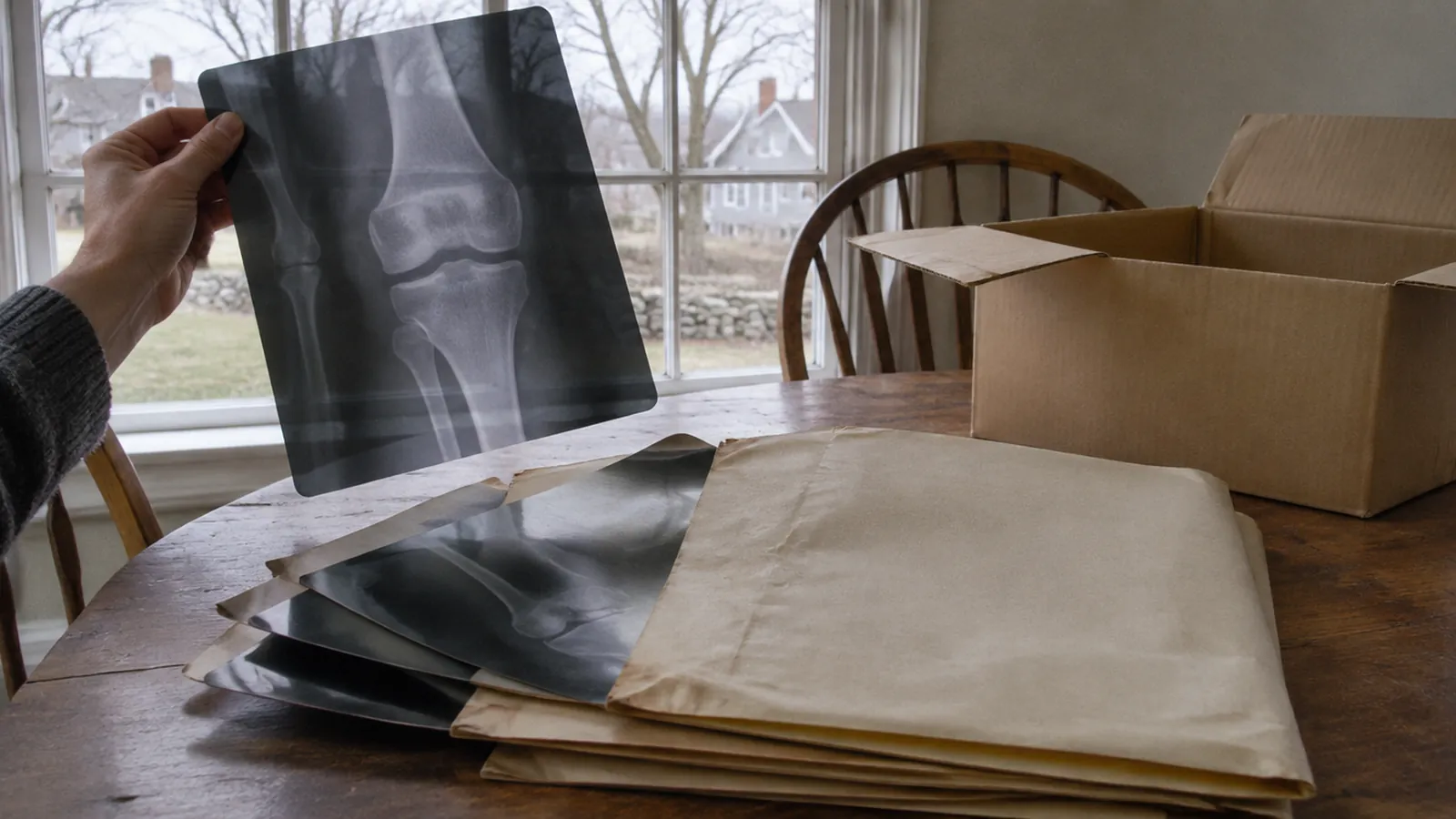
Before you shred medical X-rays, know what you are holding: a plastic sheet with a silver coating, tucked inside a paper jacket covered in your name. This post shows patients and practices how to split the film from the paper and what each one costs to destroy.
Paper jackets and reports at 99¢ per pound. Film is bagged with media and quoted before the job.
- 99¢ per pound of paper
- Since 2007
- BBB A+
- HIPAA BAA on request
Quick answer
Yes, you should destroy medical X-rays you no longer need, but do not put the film in a paper shredder or a paper box, because X-ray film is a plastic sheet coated with a silver emulsion and EPA lists silver among the metals that can make a waste hazardous. New Hampshire Document Shredding handles X-ray film with media: bag it separately and we quote it before the job, while the paper jackets, labels and radiology reports go in a box at 99 cents a pound plus $34.90 per job. Practices that need a full plan can start with our medical shredding service page.
Why you can’t shred medical X-rays like paper
People bring us X-rays two ways. Some arrive in a banker’s box, mixed in with old bills and insurance letters, as if they were just thick paper. Others come in the original large envelopes, still labeled from a hospital that may have changed its name twice since. Either way, the first thing we do is the same. We pull the film out.
A sheet of X-ray film is not paper at all. It is a clear plastic base with a light-sensitive coating on it, and that coating is built on silver compounds. Older film used acetate bases. Newer film uses polyester. Neither one behaves like paper inside a shredder, and neither one belongs in the paper recycling stream that our shred goes to.
The envelope is different. The jacket, the sticker with your name and date of birth, the folded radiology report tucked inside, the referral slip from the doctor: all of that is paper. It carries most of the readable personal information, and it shreds like any other paper. So the job is really two jobs, and you will save money and trouble by treating it that way from the start.
Even the film matters for privacy. Most films carry your name, the date and the facility printed or flashed onto the edge. A chest film from 2004 can still say exactly who you are. That is why you shouldn’t throw film in the trash whole, even though it can’t go through a home shredder like a letter.
The silver question: what EPA says about X-ray film
Silver is the reason film needs its own route. The U.S. Environmental Protection Agency’s profile of the healthcare industry describes radiology as a department that has “traditionally involved the use of film and film-developing chemicals.” In its table of hazardous waste examples, it lists “Silver from X-rays” and says silver can come from fixer and developer solutions or from film.
Under federal hazardous waste rules, a waste that leaches too much silver in EPA’s toxicity test carries hazardous waste number D011. The regulatory level in 40 CFR 261.24 is 5.0 milligrams per liter. Whether a particular batch of film crosses that line depends on the film and the amount, which is why large holders of old film should not guess.
The same EPA profile notes that new films contain less silver and that digital imaging has taken the place of many standard X-rays. Recent imaging usually lives on a hospital server or a disc, so the film people still hold tends to be older: a parent’s orthopedic films, a practice’s archive of chest films, a dentist’s pre-digital panoramic shots.
For a household with a few films, silver is not a legal problem you have to solve. It is a reason not to toss film in the paper recycling or a home shredder. For a practice with cabinets of old film, it is worth a call to your hazardous waste hauler or state environmental agency before you plan the cleanout.
Sort the envelope before you shred medical X-rays
An X-ray envelope usually holds four kinds of material. Sort them on the kitchen table or the break room counter before anything goes in a box. The diagram shows where each one ends up.
The film sheet
The image itself, on a plastic base with a silver-based coating. Large sheets for chest and spine films, small ones for dental. It goes in the media bag.
The jacket
A large paper sleeve, usually printed with the facility name and a label showing your name, birth date and a record number. Paper box.
The report
The radiologist’s written findings, sometimes folded inside the jacket. It holds diagnosis details and is the most sensitive sheet in the envelope. Paper box.
The disc
Newer studies often come on a CD or DVD instead of film. A disc is media, not paper. It goes in the bag with the film and is quoted the same way.
Don’t bother removing staples, paper clips or the metal clasp on a jacket. We shred through them. Do take out any three-ring binder hardware if a practice stored reports in binders, and keep film out of the paper boxes entirely, even a single sheet. Our post on how to prepare documents for shredding covers the rest of the packing rules.
For patients: should you shred medical X-rays you have at home?
Most households that call us about X-rays found them while clearing a closet or a parent’s house. A few films from a broken wrist in the 1990s, a dental panoramic, a set of spine films from a back injury. The first question is not how to destroy them. It is whether you still need them.
Ask yourself two things. Is anyone still treating the condition the films show? Doctors sometimes compare a new image with an old one to see change over time. And does the facility that took them still have a copy? If the answer to the first is yes, call the doctor’s office before you destroy anything.
HIPAA’s disposal duties apply to covered entities such as hospitals, practices and health plans, and to their business associates. Once films are in your own hands, how you get rid of them is your decision. That doesn’t make them less personal. The FTC’s medical identity theft advice tells consumers to shred medical and insurance papers before throwing them away, and the label on an X-ray jacket is exactly that kind of paper.

Here is how we suggest a household handles a few X-rays from start to finish.
- Check you are done with them. If a condition is still being treated, ask the doctor’s office whether they want the films or already hold a copy. Keep anything they ask you to keep.
- Open every envelope. Pull the film sheets out and stack them. Put the jackets, labels and reports in a paper box or bag with your other old medical paperwork.
- Bag the film and any discs. Use a separate sturdy bag or a small box marked “film.” Count the sheets roughly, since that helps us quote.
- Call or book. Tell us how many films and discs you have, and we quote the media before the job. The paper side is priced by the pound like any drop-off.
- Bring both together. One trip, one set of per-job fees. The paper is shredded the same business day at our Tewksbury office, and you get a Certificate of Destruction.
If the films are part of a bigger clear-out, the paper in that house almost always outweighs the film. Our guide on how to dispose of old medical records covers bills, Explanation of Benefits letters and pharmacy printouts, and our post on EOB retention tells you which of those letters to keep a while longer.
For practices: X-ray film is still protected health information
For a hospital department, a chiropractor, an orthopedic group or a dental office, the rules are different. An X-ray with a patient’s name on it is protected health information whether it sits on paper, film or a server. The format changes how you destroy it, not whether you have to protect it.
The Privacy Rule’s safeguard standard at 45 CFR 164.530(c)(1) says a covered entity “must have in place appropriate administrative, technical, and physical safeguards to protect the privacy of protected health information.” Leaving a cabinet of old films for a general junk hauler, or putting them out with the regular trash, fails that test. Images stored digitally, and the drives and discs they live on, fall under the Security Rule’s media disposal standard as well.
- Inventory the film before the cleanout: rough count, years covered, which cabinets
- Check your retention schedule and state rules before anything is destroyed
- Separate film and discs from paper charts and reports
- Ask for a Business Associate Agreement if your policy calls for one. It is available on request
- Keep the Certificate of Destruction with your disposal log
- Route old fixer, developer and any silver recovery units through your hazardous waste vendor
Paper PHI is the easy part. Our posts on HIPAA shredding requirements and dental office shredding walk through the paper rules and the paperwork we give a practice.
Patients and practices side by side
The same envelope means different things depending on who is holding it. This table sums up the differences we explain most often at the counter.
| Question | A patient at home | A practice or hospital department |
|---|---|---|
| Does HIPAA govern disposal? | No. HIPAA covers covered entities and their business associates | Yes. 45 CFR 164.530(c) safeguards apply to PHI in any form |
| Should you check before destroying? | Ask the treating doctor if a condition is ongoing | Check your retention schedule and any state record rules |
| Typical volume | A handful of films and a few reports | Cabinets or boxes of film, often years of archive |
| Silver and hazardous waste | Not your legal problem, but keep film out of paper recycling | Ask your hazardous waste vendor about silver-bearing film and chemicals |
| How to pack | Paper in a box, film and discs in a separate bag | Same, with film boxed by cabinet so the count is easy |
| Paperwork you get | Certificate of Destruction | Certificate of Destruction, and a BAA on request |
| Best service | Drop-off in Tewksbury | Pickup by zone, or witnessed shredding for the paper |
One thing does not change between the columns. The paper inside the envelope is usually the most readable part, and it is the cheapest part to destroy. Never leave the jackets out of the job just because the film is the headline.
What it costs to clear X-rays and the paper around them
Film and discs are quoted separately because they are not priced by the pound like paper. The paper side follows our standard shredding rates: 99 cents a pound under 10 boxes, $15 per small or $20 per large banker’s box at 10 boxes or more, plus $34.90 per job. A full banker’s box of paper weighs about 30 pounds. The chart shows the paper side of a cleanout at our counter and with a Zone 2 pickup from greater Nashua or Manchester.
| Paper boxes | Drop-off | Zone 1 pickup | Zone 2 pickup | Zone 3 pickup |
|---|---|---|---|---|
| 1 box | $64.60 | $194.55 | $224.55 | $264.55 |
| 5 boxes | $183.40 | $313.35 | $343.35 | $383.35 |
| 10 boxes | $234.90 | $364.85 | $394.85 | $434.85 |
| 20 boxes | $434.90 | $564.85 | $594.85 | $634.85 |
Zone 1 covers the Tewksbury area and New Hampshire border towns such as Salem, Pelham, Windham and Plaistow at $129.95. Zone 2 is greater Nashua and Manchester at $159.95. Zone 3 is the Seacoast and points farther north at $199.95. For other towns, the zone is confirmed when you book. Pickup assumes ground-level or elevator access, and a handling fee for stairs is quoted up front.
A household with five films and a shoebox of reports usually pays the per-pound rate on a few pounds of paper, the $34.90 in fees, and the media quote. A practice clearing an archive should call first, because the film count drives the quote more than the paper does.
Bringing film and paper to Tewksbury
Our only location is 1215 Main Street, Unit 115, Tewksbury, MA, on Route 38 near the I-495 interchange. It is about 15 minutes south of the New Hampshire line at Salem and Pelham. Walk-in drop-off runs Monday to Friday, 10 a.m. to 5 p.m. Parking is free out front, and staff help you unload.
Call ahead when film is part of the job. Tell us roughly how many sheets and discs you have, and we quote the media before you come. Paper you bring on a weekday is shredded the same business day, and you can read more about the counter process on our drop-off shredding page.
Practices that want to see their paper destroyed can book a witnessed session at $1.99 a pound with a $100 minimum on the shredding charge, plus the $34.90 per-job fees. The certificate is signed in front of you. Film and discs in the same visit are still quoted separately.
Every job ends with a Certificate of Destruction. It names the job, the date and what was destroyed. Our page on the certificate of destruction shows what a practice should file with it.
If you want to shred a few medical papers at home instead, our post on how to shred medical records at home covers the paper. Keep the film out of a home shredder and bring it to us with the next box.
Frequently asked questions
Can I put old X-rays through my home shredder?
We don’t recommend it. X-ray film is a plastic sheet with a silver-based coating, not paper, and many home shredders are built for paper only. Check your shredder’s manual before feeding anything else through it. Shred the paper jackets and reports at home if you like, and bag the film to bring to us.
Can I recycle X-ray film with my paper?
No. Film is not paper and does not belong in paper recycling. EPA lists silver from X-rays among the sources of silver in healthcare waste, and silver carries hazardous waste code D011. Keep film out of the recycling bin and out of our paper boxes. Bag it separately and we handle it with media.
How much does it cost to destroy X-ray film?
Film and image discs are quoted before the job because they are not priced by the pound. Tell us roughly how many sheets you have when you call or book. The paper jackets and reports are 99 cents a pound under 10 boxes, plus $34.90 per job, so one box of paper comes to about $64.60.
Should I keep my X-rays instead of destroying them?
Keep them if a condition is still being treated and your doctor might compare old and new images. Call the office first. Many facilities keep their own copies, and newer imaging is usually stored digitally. If nobody is treating the condition and the facility has a copy, you can destroy your films.
Does HIPAA apply to X-rays I have at home?
HIPAA’s disposal duties apply to covered entities, such as practices, hospitals and health plans, and to their business associates. Films in your own hands are yours to dispose of. They still carry your name, birth date and medical details, so treat them as private and never put them out with the trash whole.
What should a dental or medical practice do with an archive of old film?
Check your retention schedule first, then inventory the film and separate it from paper charts. Call us with a rough count so we can quote the film and plan a pickup by zone. Ask your hazardous waste vendor about old fixer, developer and silver recovery units. A BAA is available on request.
Do I need to take the film out of the paper jacket?
Yes. The jacket and any report go in the paper box at 99 cents a pound. The film goes in a separate bag with any discs. You don’t need to remove staples, clips or the metal clasp on a jacket. Sorting at home keeps the job quick at the counter.
Do you have a drop-off location in New Hampshire?
No. Our only location is 1215 Main Street, Unit 115, Tewksbury, MA, about 15 minutes south of the New Hampshire line at Salem and Pelham. You can drive your boxes and film down on a weekday, or book a pickup priced by zone from $129.95. We shred everything at the Tewksbury office.
Sources
- U.S. EPA, Profile of the Healthcare Industry, Sector Notebook (February 2005) (checked November 2026)
- 40 CFR 261.24, Toxicity characteristic (govinfo.gov) (checked November 2026)
- 45 CFR 164.530(c), HIPAA safeguards (govinfo.gov) (checked November 2026)
- Federal Trade Commission, What To Know About Medical Identity Theft (checked November 2026)
Get the film and the paper off your hands
Sort the envelopes, bag the film, box the paper and give us a call with a rough count. We quote the film before the job, shred the paper by the pound and hand you a Certificate of Destruction for both.
Where we shred
1215 Main Street, Unit 115, Tewksbury, MA 01876. Route 38, near I-495. Free parking out front.
Monday to Friday, 10 a.m. to 5 p.m. Witnessed sessions and pickups outside these hours by appointment.
- Drop-off: walk in, 99¢ per pound
- Pickup: from $129.95 by zone
- Witnessed: $1.99 per pound, $100 minimum
New Hampshire Document Shredding · 1215 Main Street, Unit 115, Tewksbury, MA 01876 · (978) 636-0301 · Monday to Friday, 10 a.m. to 5 p.m.