
Updated November 2026 · Southern New Hampshire
Witnessed shredding: watch your documents shredded in Tewksbury
Book a time, drive down from New Hampshire, and stand beside the shredder while every page goes in. You leave with a Certificate of Destruction signed in front of you, at $1.99 per pound with a $100 job minimum.
$1.99 per pound, $100 minimum on the shredding charge, plus $34.90 per-job fees. By appointment only.
- $1.99 per pound
- Since 2007
- BBB A+
- HIPAA BAA on request
Quick answer
Witnessed shredding at New Hampshire Document Shredding means you book an appointment at our office at 1215 Main Street, Unit 115, Tewksbury, MA, about 15 minutes south of the New Hampshire line, and watch your paper go through the shredder yourself. It costs $1.99 per pound with a $100 minimum on the shredding charge, plus $34.90 in per-job fees, so 100 pounds comes to $233.90. The Certificate of Destruction is signed in front of you before you leave.
What witnessed shredding means at our office
Most of our document shredding happens without the customer in the room. You hand boxes over at the counter, or a driver collects them from your building, and the paper is shredded at the Tewksbury office afterward. A Certificate of Destruction follows. That process is locked down from start to finish, and for most households and offices it is all they will ever need.
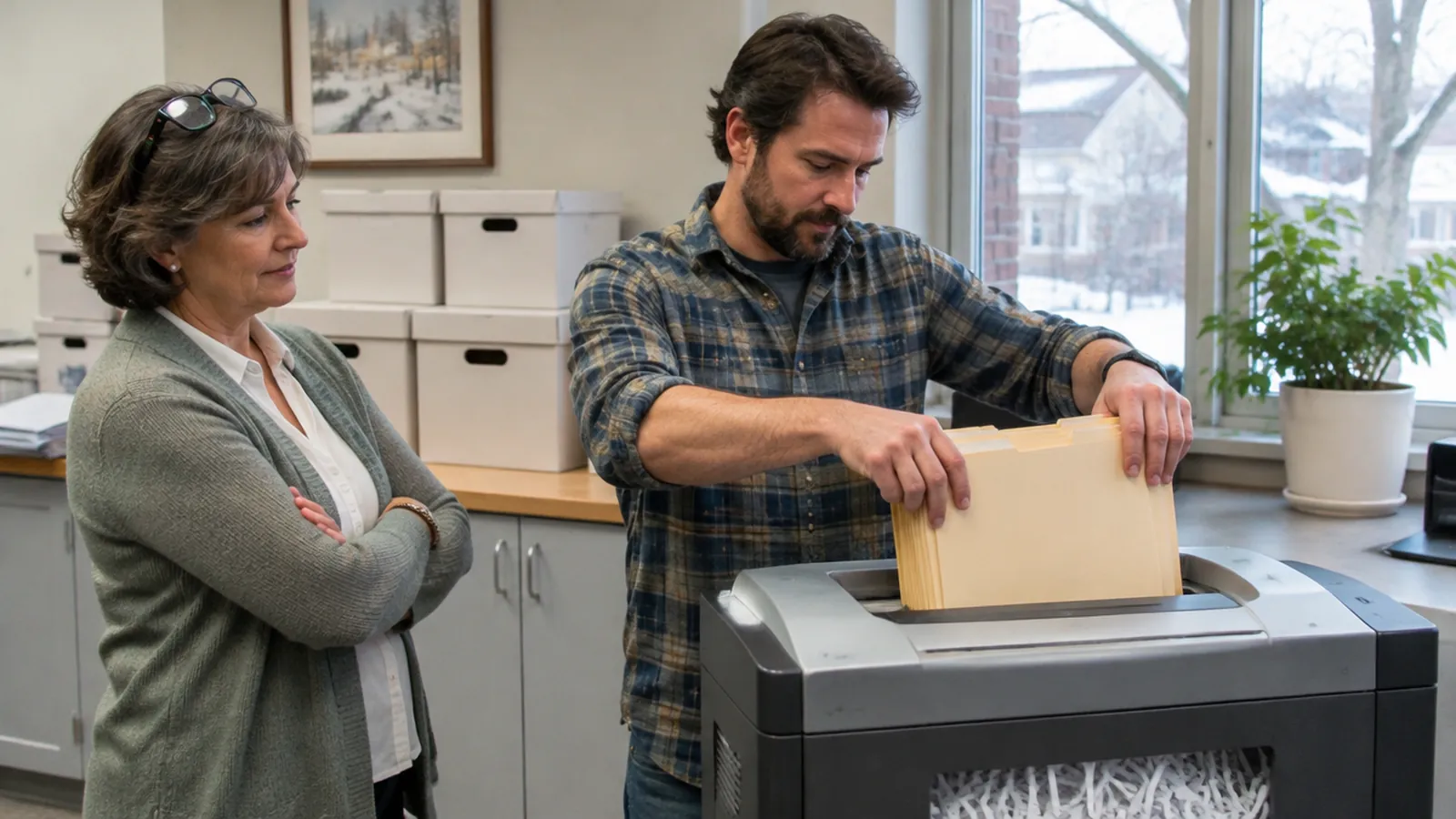
Witnessed shredding closes the last gap, which is you. You book a time, you bring the boxes, and you stand where you can see the paper go into the shredder. Nobody carries a box into a back room while you wait in the lobby. When the last page is gone, the certificate is filled in and signed while you are still standing there.
It happens in one place only: our office at 1215 Main Street, Unit 115, in Tewksbury, Massachusetts. That is on Route 38 near the I-495 interchange, about 15 minutes south of the state line at Salem and Pelham by I-93 or Route 38. There is no truck that shreds in your driveway and no New Hampshire storefront. If you want to watch, you drive down.
A witnessed session also costs more than our other shredding services: $1.99 per pound against 99 cents at the drop-off counter. You are paying for a booked slot, a staff member who works your job from the scale to the certificate, and your own eyes on every box. For some files that is money well spent. For a closet of old utility bills it is not, and we will tell you so when you call.

Who books a witnessed session
Nobody needs a reason to watch. Still, after years of these appointments, the people who book them tend to fall into a few groups. Each one has a slightly different idea of what “seeing it happen” protects.
Law firms closing out files
A matter closes, the retention period runs out, and someone has to sign off on destroying the file. Many partners would rather see it go than take the job on trust. Bring the closed files, a list of matter numbers if your policy asks for one, and the person who signs. For routine volume, our page on pickup shredding for NH law firms covers the cheaper route.
Executives and HR
Personnel files, discipline records, salary reviews, leave paperwork, severance agreements and old board packets. The fewer hands those pages pass through, the better. A witnessed session lets the person responsible for the file carry it from the office to the shredder without handing it to anyone else in between.
Estates and executors
Sorting a parent’s papers is slow and personal. Once you have set aside what the estate attorney and the final tax returns need, some executors want to see the rest destroyed themselves, sometimes with a brother or sister along. Our estate cleanout shredding page lists what to keep before you shred anything.
Audit and legal-hold releases
Records that sat under a litigation hold, or waited for an audit to close, are the ones someone may ask about later. Once counsel releases the hold in writing, the person who signed the release can watch the destruction and file the certificate with the release memo. A written records destruction policy should say who does this.
Practice and compliance managers
A one-time purge of old charts is a good moment for a privacy officer to see the process first-hand. HIPAA asks covered entities to safeguard paper records through disposal, and a Business Associate Agreement is available on request. Our medical shredding service page covers regular practice volume.
Anyone who wants to see it
Some customers have been through identity theft and do not trust any process they cannot see. Others had a bad experience with an office shredding bin that sat open in a hallway for a week. You do not need a legal reason. If watching is what lets you finally close the box, book the session.
What you see from arrival to certificate
A witnessed appointment follows the same order every time. Here it is from the moment you pull into the lot on Main Street to the moment you drive back toward New Hampshire.
- Arrive and unload. Park free out front at 1215 Main Street. Staff come out and help you bring the boxes in, so a hand truck at home is optional. Aim to arrive a few minutes before your slot.
- Check in. We confirm the booking, your name and who will sign for the job. If you brought hard drives or other media, they go aside in their own bag, because media is quoted per item and handled separately from paper.
- Weigh the boxes. Every box goes on the scale where you can read it. We multiply the weight by $1.99, apply the $100 minimum if the load is light, add the $34.90 per-job fees, and tell you the total before anything is shredded.
- Last look. This is your final chance to pull out the deed, the passport or the one folder you meant to keep. Three-ring binder hardware and hanging-folder frames come out now if they are still in the boxes.
- Watch it shredded. Staff feed the paper into the cross-cut shredder while you stand and watch. Boxes stay in view the whole time and none of them leaves the room unshredded.
- Sign and go. The Certificate of Destruction is filled in and signed in front of you, and you leave with it. The shred goes to recycling, as 100 percent of our shredded paper does.
Keep the certificate with whatever record your office uses to track destruction: a closing memo, a retention log, the estate file. Our guide to what a certificate of destruction should contain explains what to check on it and how long to hold onto it.
How long a session takes
The honest answer is that it depends on how much you bring and how ready it is. Paper that arrives in lidded boxes, with binders already stripped, moves fast. Paper that arrives in trash bags with three-ring binders and a few hanging-folder racks mixed in takes longer, because those have to come out before the shredder can take the load.
Use the table below to plan your day and your parking meter, not as a promise. A standard banker’s box of paper weighs about 30 pounds, so the box counts are rounded from that.
| Volume | About how many banker’s boxes | Rough time to plan at the office |
|---|---|---|
| Up to 50 pounds | 1 to 2 | About 20 to 30 minutes |
| 100 pounds | 3 to 4 | About 30 to 45 minutes |
| 200 pounds | 6 to 7 | About 45 minutes to an hour |
| 400 pounds | 13 to 14 | About 1 to 2 hours |
| More than 400 pounds | 15 or more | Ask when you book, we may suggest two sessions |
These times are a planning guide based on clean, boxed paper. They are not a guaranteed session length. Tell us your volume when you book and we will set aside a window that fits it, and add your drive time from New Hampshire on top.
Large loads raise a fair question: do you need to watch all of it? A firm closing 40 boxes of files may only have six that truly need a witness, such as one sensitive matter or a set of partner files. Witness those six, send the rest through regular drop-off or a pickup, and the bill drops by a dollar a pound on everything you did not need to see.
Your drive is the other half of the time. From the Salem or Pelham line it is about 15 minutes to Main Street. From Nashua, Manchester or the Seacoast, check the traffic before you leave and build in a cushion. Our service areas page lists the New Hampshire towns we serve and how each one gets to us.
What witnessed shredding costs
The math has three parts. First, the shredding charge, which is the weight times $1.99. Second, the $100 job minimum, which applies to that shredding charge only, before fees. Third, the $34.90 in per-job fees that every job carries: a $14.95 HIPAA filing fee that covers the Certificate of Destruction paperwork and a $19.95 environmental fee that covers recycling the shred.
That minimum matters for small loads. Fifty pounds at $1.99 is $99.50, so it rounds up to the $100 minimum and the bill is $134.90. Anything up to about 50 pounds costs that same $134.90. Above that line, every extra pound adds $1.99.
| Weight | Witnessed shredding charge | Per-job fees | Witnessed total | Same weight at drop-off | What watching adds |
|---|---|---|---|---|---|
| 50 pounds | $99.50, raised to the $100 minimum | $34.90 | $134.90 | $84.40 | $50.50 |
| 100 pounds | $199.00 | $34.90 | $233.90 | $133.90 | $100.00 |
| 200 pounds | $398.00 | $34.90 | $432.90 | $232.90 | $200.00 |
| 400 pounds | $796.00 | $34.90 | $830.90 | $430.90 | $400.00 |
Above the minimum, the gap between witnessed and drop-off is easy to remember: one dollar per pound. At 400 pounds it is $400. If those 400 pounds come in as 13 large banker’s boxes, the drop-off side gets cheaper still, because the flat rate of $20 per large box kicks in at 10 or more boxes, which is $260 plus fees, or $294.90. The full price list, including small-box rates and pickup zones, sits on our shredding rates page.
None of this means witnessed shredding is a bad deal. It means you should pay for it on the boxes where watching matters and not on the rest.
Witnessed vs drop-off vs pickup
All three services end in the same place, a cross-cut shredder at the Tewksbury office and a Certificate of Destruction. What changes is who moves the boxes, whether you need an appointment, and if you are in the room.
| Witnessed | Drop-off | Pickup (off-site) | |
|---|---|---|---|
| Where it is shredded | Tewksbury office, while you watch | Tewksbury office, same business day | Tewksbury office, after the boxes arrive |
| Appointment | Required | No, walk in weekdays 10 a.m. to 5 p.m. | Required |
| Shredding price | $1.99 per pound, $100 minimum | 99¢ per pound, or $15 small and $20 large box at 10+ boxes | Same as drop-off |
| Transportation | You drive | You drive | Zone 1 $129.95, Zone 2 $159.95, Zone 3 $199.95 |
| Per-job fees | $34.90 | $34.90 | $34.90 |
| Do you see it shredded | Yes, every box | No, you hand boxes over at the counter | No, the driver takes the boxes |
| Certificate of Destruction | Signed in front of you | Included | Included |
| 100 pounds, total | $233.90 | $133.90 | $263.85 in Zone 1 |
| Best for | Files someone must see destroyed | Households and small offices near the line | Offices with many boxes or no one free to drive |
Here is the rule of thumb we give at the counter. For three boxes of household paper, drive down and use drop-off shredding. For thirty boxes at an office in Nashua, book a pickup. For the handful of files someone has to sign off on personally, book a witnessed session and bring only those.
One result surprises people. For small loads, watching can cost less than a pickup. A pickup adds a transportation fee by zone, while a witnessed session adds a dollar a pound. Below about 130 pounds, a witnessed session is cheaper than a Zone 1 pickup. Below about 160 pounds it beats Zone 2, and below about 200 pounds it beats Zone 3. You do the driving, of course.
The trade-off flips at volume. Once you pass ten boxes, pickup and drop-off both switch to flat box rates, and the per-pound premium for watching starts to add up fast. Our off-site shredding page explains the zones, the access rule and what the driver does at your door.
For worked break-even examples by volume and zone, see the drop-off vs off-site comparison. If you are still deciding whether your files need a witness at all, our article on when witnessed shredding is worth it walks through legal holds, executive files, estates and audits one at a time.
What to bring and how to prep
A witnessed session goes best when the only thing left to do at the office is shred. Most of the prep happens at your kitchen table or in your file room the week before.
- Your boxes, ideally banker’s boxes with lids, so they stack and carry without spilling.
- A list of what is in them if your policy, client agreement or court order asks for an inventory.
- The person who will sign for the job. If a partner, executor or compliance officer must be the witness, that person comes.
- Any paperwork that gives you the authority to destroy the records, such as a written hold release or the estate appointment, if your own process needs it on file.
- Hard drives, USB sticks, tapes or phones in a separate bag, mentioned when you book, since media is quoted per item.
You do not need to pull staples, paper clips, binder clips or rubber bands. File folders can go in as they are. That saves hours on a big purge, so do not spend an evening with a staple remover.
Two things do have to come out: three-ring binder hardware and hanging-folder frames. Pop the rings open and drop the paper back in the box. Anything that is not paper, from a spiral calendar’s plastic cover to a CD in a sleeve, goes in the media bag.
Before you seal a box, check it against your retention schedule. The IRS generally points to three years for tax records, longer in some cases, and our document retention guide covers the household and business records New Hampshire customers ask about most. The step-by-step version of all this lives in how to prepare documents for shredding.
How to book a witnessed session
Booking takes a few minutes online or by phone. The more we know up front, the better we can size your time slot.
- Estimate your volume. Count the boxes and multiply by about 30 pounds for a full banker’s box of paper. A rough number is fine, since the scale settles the bill.
- Book online or call. Use the Book online form or call (978) 636-0301. Ask for a witnessed session so we hold staff time for you.
- Tell us the details. Mention the box count, any media, who is coming, and whether you need a Business Associate Agreement for HIPAA records before the day.
- Get your time confirmed. Office hours are Monday to Friday, 10 a.m. to 5 p.m. Witnessed sessions outside those hours are possible by appointment, so ask if a weekday afternoon will not work.
- Prep and drive down. Strip binders, bag the media, load the car, and head for 1215 Main Street, Unit 115. We help you unload when you arrive.
If you need to change the time, call us as early as you can so we can move the staff time. Questions about anything on this page can also go through our contact page.
Do the rules say you have to watch?
Usually not. The federal disposal rules our customers deal with most focus on the result, paper that cannot be read or put back together, and on choosing a careful vendor. Watching is one way to satisfy yourself about both. It is rarely written into the rule itself.
The FTC Disposal Rule, 16 CFR Part 682, applies to anyone who keeps consumer report information for a business purpose. Section 682.3 gives the burning, pulverizing or shredding of papers so the information cannot practicably be read or reconstructed as an example of a reasonable measure. It also lists hiring a record destruction company after due diligence, such as checking references or reviewing an audit of its operations.
HIPAA works the same way. The Privacy Rule at 45 CFR 164.530(c) requires covered entities to have appropriate administrative, technical and physical safeguards for protected health information. The Security Rule at 45 CFR 164.310(d)(2)(i) requires policies for the final disposition of electronic health information and the media it lives on. Neither section says a staff member has to stand at the shredder. Our page on HIPAA shredding requirements goes through what each rule asks for.
New Hampshire’s breach notice law, RSA 359-C:20, is written around computerized personal information. It requires a business that discovers a breach to notify affected residents and, in most cases, the Attorney General’s office. Shredding paper properly is about keeping old records from ever turning into that kind of problem.
So where does a witness requirement come from? Mostly from inside your own organization or your client relationships. A firm’s file-closing policy, a client engagement letter, a settlement term, an insurer, or a board resolution may ask for it. When one of those does, the witnessed session and the signed certificate give you the record to prove it was followed.
Witnessing is your choice under the federal rules quoted here. If a policy, contract or court order you are bound by says someone must watch, follow that document and bring a copy of the requirement to your session.
Retention comes before destruction. The IRS says to keep most income tax records for three years, six years if income was underreported by more than 25 percent, seven years for a bad debt or worthless securities claim, and four years for employment tax records. Shred after those clocks run out, not before.
Frequently asked questions
How much does witnessed shredding cost?
Witnessed shredding costs $1.99 per pound with a $100 minimum on the shredding charge, plus $34.90 in per-job fees ($14.95 HIPAA filing and $19.95 environmental). Fifty pounds comes to $134.90, 100 pounds to $233.90, 200 pounds to $432.90 and 400 pounds to $830.90. You see the scale and the total before anything is shredded.
Does the $100 minimum include the fees?
No. The $100 minimum applies to the shredding charge alone. The $34.90 per-job fees are added on top, so the smallest witnessed bill is $134.90. Any load up to about 50 pounds lands at that number, because 50 pounds at $1.99 is $99.50 and rounds up to the minimum.
Can I watch my documents shredded at my office in New Hampshire?
Not in New Hampshire. Witnessed shredding happens only at our office at 1215 Main Street, Unit 115, Tewksbury, MA, about 15 minutes south of the Salem and Pelham line. We do not shred at your address or from a truck at the curb. If you cannot drive down, a pickup is the alternative, though the paper is shredded at Tewksbury without you present.
How long does a witnessed session take?
As a rough planning guide, one or two boxes take about 20 to 30 minutes at the office, and a load of around 400 pounds can take one to two hours. Prep makes the biggest difference. Boxed paper with binders already removed moves faster. Tell us your volume when you book and we will set a fitting time window.
Do I need to remove staples and paper clips first?
No. Staples, paper clips, binder clips, rubber bands and file folders can stay. Please remove three-ring binder hardware and hanging-folder frames before your session, and put anything that is not paper, such as CDs, drives or USB sticks, in a separate bag. Media is quoted per item and handled apart from the paper.
Can I bring hard drives to a witnessed session?
Tell us when you book. Hard drives, tapes, CDs, USB sticks and phones are physically destroyed and quoted per item, separate from the per-pound paper price. Bring them in their own bag and we will go over the quote and handling with you at check-in. Our hard drive destruction page has more detail on media.
What do I leave with?
You leave with a Certificate of Destruction that is filled in and signed in front of you once the last box is shredded. It is included with every job and covered by the $14.95 HIPAA filing fee. File it with your closing memo, retention log or estate records so you can show when and how the material was destroyed.
Can I book outside regular hours?
Our office hours are Monday to Friday, 10 a.m. to 5 p.m. Eastern. Witnessed sessions outside those hours can be arranged by appointment. Call (978) 636-0301 or use the online booking form and tell us what time works for you, and we will confirm what we can offer.
Does HIPAA require witnessed shredding?
The HIPAA sections we cite, 45 CFR 164.530(c) and 164.310(d)(2)(i), require safeguards and disposal policies, not a witness at the shredder. Many practices use drop-off or pickup with a certificate. Some privacy officers still choose to watch a large purge. A Business Associate Agreement is available on request for covered entities and business associates.
Sources
- 16 CFR Part 682, Disposal of Consumer Report Information and Records (eCFR) (checked November 2026)
- 45 CFR 164.530, HIPAA Privacy Rule administrative requirements (eCFR) (checked November 2026)
- 45 CFR 164.310, HIPAA Security Rule physical safeguards (eCFR) (checked November 2026)
- New Hampshire RSA 359-C:20, notice of security breach (NH General Court) (checked November 2026)
- IRS, How long should I keep records (checked November 2026)
Book a time to watch your files shredded
Pick a slot, bring the boxes that need a witness, and leave with a signed Certificate of Destruction. $1.99 per pound, $100 minimum, plus $34.90 in per-job fees, at our office just south of the New Hampshire line.
New Hampshire Document Shredding
1215 Main Street, Unit 115, Tewksbury, MA 01876. Route 38 near I-495, about 15 minutes from the Salem and Pelham line. Free parking out front.
Monday to Friday, 10 a.m. to 5 p.m. Witnessed sessions and pickups outside these hours by appointment.
- Witnessed: $1.99 per pound, $100 minimum, by appointment
- Drop-off: 99¢ per pound, walk in on weekdays
- Pickup: same shredding rates plus a zone fee, by appointment
New Hampshire Document Shredding · 1215 Main Street, Unit 115, Tewksbury, MA 01876 · (978) 636-0301 · Monday to Friday, 10 a.m. to 5 p.m.